Sign up for the daily CJR newsletter.
At 12:37pm EST on June 25, Jodie Ginsberg, the chief executive of the Committee to Protect Journalists (CPJ), announced that the organization was reexamining the names in its database of journalists killed in the Israel-Gaza war. “CPJ condemns in no uncertain terms the misrepresentation of combatants as journalists or media workers—or the misuse of ‘Press’ insignia. Such actions endanger every single individual journalist legitimately trying to report,” she said in a statement. “We are conducting a full review of the names on our lists to confirm that no one who was actively engaged in combat is listed in our data.” Ginsberg also pointed out that “in-person verification by researchers from outside Gaza has been impossible” because, as Gerry Shih wrote for CJR’s recent Access Issue, since the war began, Israel has barred international correspondents and press advocates from reporting independently in the territory.
Four hours later, at 4:47pm, Jacob Weisberg—the chair of CPJ’s board of directors and a cofounder of Pushkin Industries—emailed the board with an update on a parallel but distinct plan to reconsider who counts as a member of the press. He wrote, according to emails I have reviewed, that he’d established a “special task force to reexamine the question of ‘Who is a Journalist?’” He told board members: “This inquiry is not limited to Gaza, and will address questions about our protection of journalists affiliated with the non-military wings of identified terrorist organizations as well as journalists engaged in official propaganda or disinformation.” He said that nine people had already agreed to work on the task force, and that they would share their recommendation with the board at the next scheduled meeting, in October. (In response to interview requests, Weisberg referred to public statements and said that he was “not going to comment on the board’s internal discussions or processes.”)
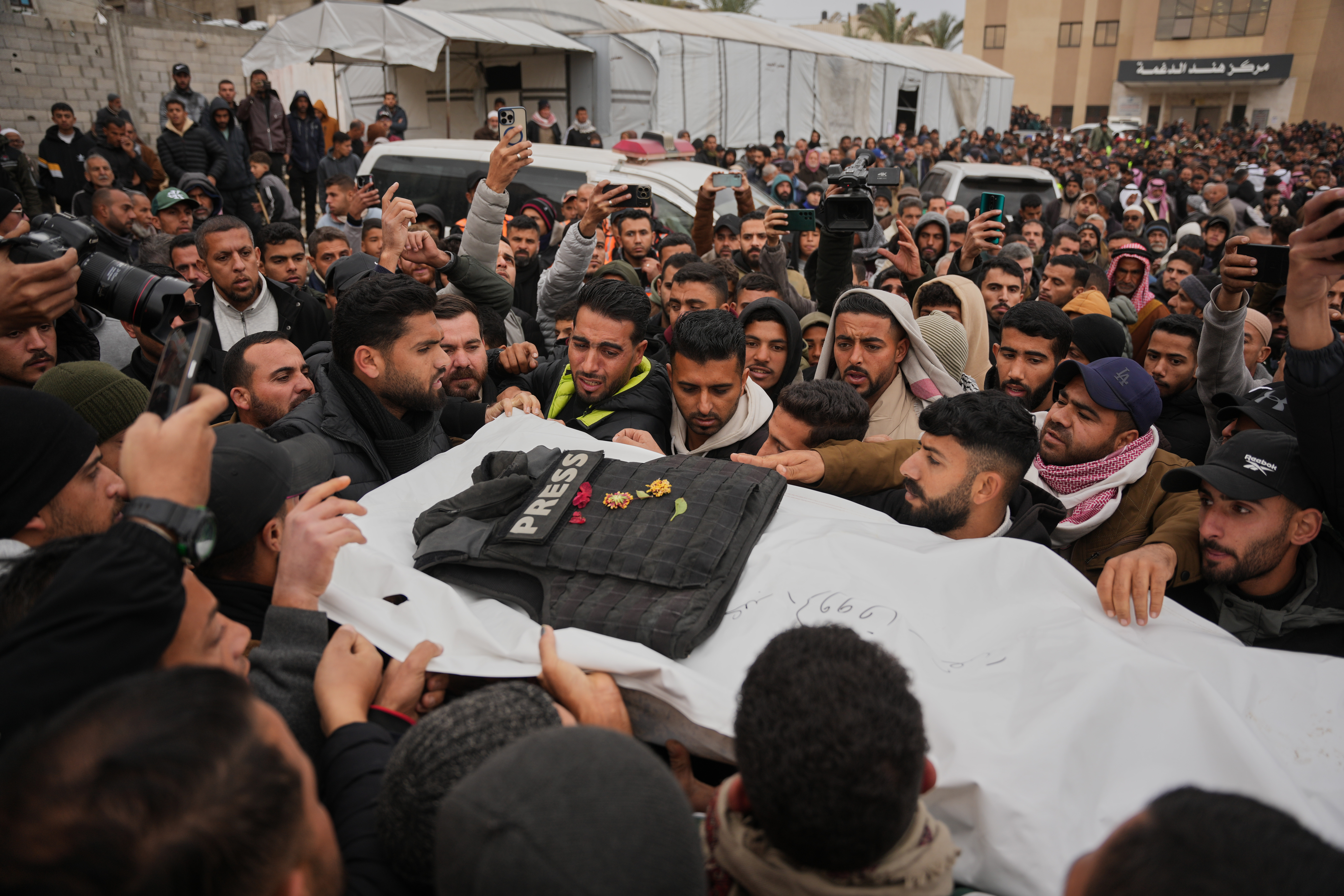
The pair of announcements, one public and the other intended to be private, quickly set off a widespread debate about whether one of the world’s most influential press advocacy groups was caving to political pressure. Since the Israel-Gaza war began, in October of 2023, CPJ—a nonprofit headquartered in New York that promotes global press freedom, provides safety support to reporters, and produces research about attacks on the press—has kept a well-sourced and widely cited count of journalists killed. CPJ says the database records people’s names only after its researchers, based around the world, have confirmed via “at least two independent sources of information, desk-based research, and in-person research where possible” that each person is a journalist who has been killed in relation to their work. (Supporting evidence can include information from “family, colleagues, media reports, civil society, and government or independent investigations,” according to CPJ’s methodology.) The tally, at present, documents two hundred and sixty-three journalists and media workers killed in Gaza, Iran, Lebanon, and Yemen, the vast majority of them by the Israeli military, which routinely targets journalists and accuses them, without evidence, of being terrorists. CPJ’s research puts Israel’s war on Gaza down as the deadliest conflict for journalists on record. This has made the CPJ database, and the methodology behind it, a target for attacks by those seeking to discredit critics of the Benjamin Netanyahu administration.
These attacks have grown louder in recent weeks, in the wake of an article by Nicholas Kristof, published on May 11 in the New York Times’ opinion section, that reported on allegations of sexual violence perpetrated by the Israeli military, titled “The Silence That Meets the Rape of Palestinians.” A right-wing news site called the Washington Free Beacon—which once ran a piece with the headline “January 6: An Anniversary Worth Celebrating”—has since published a string of articles seeking to discredit Kristof, his sources, his family members, and the organizations he cited, including CPJ. On May 23, the Free Beacon ran a story saying that CPJ had removed some names from its database of killed journalists. (The same Beacon article quoted a spokesman for Honest Reporting—an organization that Reporters Without Borders has said “constantly defames journalists and media outlets that take a critical view of Israel”—who made the absurd allegation that news organizations citing CPJ data were “amplifying Hamas propaganda.”) On May 27, the Free Beacon published another article, this one accusing CPJ of anti-Israel bias and attacking its board members for, among other things, describing Israel’s actions in Gaza as a genocide.
Behind the scenes at CPJ, meanwhile, a related, though very different, conversation was taking shape. Throughout the spring, Hamas and Palestinian Islamic Jihad published obituaries or statements claiming that a number of people in CPJ’s database of journalists killed in the Israel-Gaza war were, in fact, active combatants. After further research, CPJ removed several names. That meant that, since October 7, 2023, a total of twenty people had been removed from the list once new information emerged indicating that they did not meet CPJ’s criteria—including eight people who were found to be active combatants. On May 27, CPJ updated its site to provide details on why the recent changes had been made. At the beginning of June, the organization quietly started “a comprehensive review” of its database, according to Sara Qudah, CPJ’s Middle East and North Africa regional director, who requested it. The goal was to check that everyone in the database fit the organization’s existing definition by verifying each individual’s status with at least two new independent sources; the undertaking also aims to uncover potential problems with the existing verification process. The review, which is ongoing, has been “led by a small team within the Middle East and North Africa program,” Qudah explained in an article for the New Arab, and is “entirely independent.”
Around the same time, a separate process got underway, under the auspices of CPJ’s board, which comprises almost thirty senior journalists, media executives, and leaders from related professions. (The board is not involved in the day-to-day running of the organization.) At a board meeting in early June, members discussed the recent Free Beacon coverage, and one member, Jonathan Klein, the former chief executive of Getty Images, told me that he proposed revisiting how CPJ defines a journalist. That proposal was taken up by Weisberg. “We are working on a process for the board to engage in that will allow us to consider the current definition and to assess what changes we might make,” he told the board on June 9, according to emails I have reviewed, promising “more details in the coming weeks.”
But when Weisberg sent his “Who is a Journalist?” email, on June 25, it came as a surprise to Nika Soon-Shiong, the publisher of Drop Site News and a CPJ board member since June of 2021. Though she was aware of Weisberg’s interest in the question, there had been no vote or discussion of whether to act on the proposal to reevaluate CPJ’s definition. “This was an effort led by a handful of board members to narrow the definition of who is a journalist and exclude Palestinian and Lebanese colleagues,” Soon-Shiong told me in a statement. On June 28, she sent an email to Weisberg and the rest of the board—which she later posted on X—voicing concerns. “I request that the Board vote on whether to proceed with this effort, given the absence of a clear objective, defined scope of work, or assessment of the potential institutional risks,” she wrote. Reevaluating the criteria for who counts as a journalist in a way that might exclude Palestinian and Lebanese reporters at state-backed outlets would cause “permanent reputational damage” to CPJ and would represent bowing to “political pressure,” she wrote. (Soon-Shiong also told me that, following her email, she was informed that her term on the board had expired; the set terms last five years. Weisberg declined to comment.)
The same day, Mohammed El-Kurd, a Palestinian writer and poet who serves as the Palestine correspondent at The Nation, claimed on X that CPJ’s board of directors “will formally change its definition of who qualifies as a journalist, to broadly exclude slain Palestinian and Lebanese journalists who worked for government-funded media outlets.” The move, he wrote, “makes a mockery of the purported mission of the organization.” The post sparked an immediate backlash on social media, including accusations that CPJ was acquiescing to political pressure—not entirely unheard of among media and tech organizations that have, for instance, been seen bending the knee to the Trump administration as it attacks the press.
On Wednesday, July 1, as controversy and confusion mounted over the operational review and the board’s plans, CPJ’s board held an emergency meeting and voted to affirm its existing definition of a journalist. The vote was seventeen to one, according to the Free Beacon, with “Fox News’s representative casting the lone no vote,” thereby halting the chair’s proposal. (The Beacon seemed to be referring to Katherine Meeks, the general counsel of Fox News Media, who did not respond to my request for an interview.) “It is not true that CPJ planned to change our definition of who is a journalist to exclude slain Palestinian and Lebanese press killed in the Israel-Gaza war,” Weisberg said in a statement after the vote, calling reports to the contrary “unsubstantiated allegations” that “undermine” CPJ’s work and “endanger” Palestinian and Lebanese journalists.
Some media coverage confused two discrete processes—the ongoing CPJ review of its data, on the one hand, and an unsuccessful push to reevaluate the broader definition of a journalist, on the other. The board of the Arab and Middle Eastern Journalists Association (AMEJA) requested an urgent meeting with Ginsberg, held on June 30. They came away reassured. As they wrote afterward to members, Ginsberg told them, “There has been no board decision to change the definition. And if they change the definition to exclude Palestinian journalists, they can take my resignation with it.” One person in the meeting, Aymann Ismail—the AMEJA board president and a senior writer at Slate, who spoke to me in a personal capacity—said Ginsberg made a clear distinction “between the daily operations of CPJ, and the board.” According to Ismail, Ginsberg told AMEJA that CPJ’s database review was “something that they would have been doing regardless of what the board was discussing, because they care very deeply about their rigorous processes of verification.”
CPJ had, in fact, undergone a recent stress-testing of its methodology, in 2025. In the spring of that year, staff representing all parts and regions of CPJ met four times to discuss who counted as a journalist. The meetings, according to emails I reviewed, involved “kicking the tires” of the organization’s definition and figuring out “where we most often get tripped up.” Where, exactly, is the point at which someone becomes a propagandist, an activist, an influencer, a foreign agent? CPJ staff agreed that “accuracy” and publishing “fact-based” material was crucial to inclusion as a journalist; that the medium or platform in question did not matter; that for someone to be considered a journalist, their witnessing should not be a one-off; and that CPJ should look at the individual journalist, not the organization to which they were affiliated, when determining their status. The process led to a slight tweak in CPJ’s public definition: “CPJ defines journalists as people who regularly cover news or comment on public affairs through any medium to report or share fact-based information with an audience.” (Changes in italics.) In June of 2025, the board of directors voted to adopt that definition.
CPJ’s long-standing inclusion of reporters affiliated with state-backed media or militant or armed groups has made it a target of bad-faith organizations like Honest Reporting. But it’s worth emphasizing that CPJ researchers evaluate whether people killed were genuinely engaged in regular journalistic activity, and that anyone they judge to be actively engaged in combat or inciting imminent violence is automatically excluded from the data. This is in line with how many human rights organizations define journalists. The UN Human Rights Office, for instance, has said that journalists are people “documenting events, analyzing issues, gathering facts, and processing data, to inform society on matters of public interest.” Notice: not people who work for journalistic institutions, but people doing journalism. This rubric could include journalists at Al-Aqsa TV in Gaza (affiliated with Hamas, the militant group that runs the government); Xinhua News Agency in China (owned by the one-party state); or, for that matter, Stars and Stripes (owned by the US Department of Defense) or Voice of America (overseen by the US Agency for Global Media). “We recognize that across the world, individuals working for these outlets are essential in providing information to communities,” Ginsberg has said.
Some human rights professionals argue that making the test of who is a journalist about one’s function, not the politics or affiliations of their employer, is important because witnesses who work for one political group or another are more likely to be found in places where ordinary reporting is suppressed or access is denied. Amos Barshad has documented for CJR how international journalists have been trying to get into Gaza for years. Does that not make any bona fide journalistic work on the ground there a public service? A vital way of recording a war that would otherwise go unseen? And if someone is killed for doing that journalistic work—for performing the role of witness, even if they report for a state-owned media organization affiliated with a group whose politics we may find grotesque—why should they be excluded from a tally of journalists slain for doing their jobs?
Ismail, of AMEJA, told me that, following his meeting with Ginsberg, it became clear that the two separate reviews were being conflated in some reports and on social media. He added, though, that he understood why the misunderstanding had elicited such a fierce response. “This is emotional for so many people, for obvious reasons. This is a matter of life and death,” he said. “We’ve seen so many examples of the Israeli military justifying the killing of journalists who no one would question their status as journalists.” He noted the grim emergence of a new term used by the Israel Defense Forces: “They were calling these people ‘combat propagandists.’ It’s not a thing. And even if that were the case—where somebody was on someone’s bankroll—that does not make them a military target.”
Other Notable Stories …
By Jem Bartholomew
- On Tuesday, NPR published—then quickly retracted—an article by Nina Totenberg, NPR’s Supreme Court correspondent, stating, incorrectly, that Samuel Alito, a Supreme Court Justice, had retired. Totenberg, who is eighty-two and has been a well-sourced reporter on that beat for decades, apologized to Alito and called it her “worst professional mistake of my more than fifty years in journalism.” Totenberg explained that the error grew out of her having misheard the answer to a question: “I asked somebody what was going on inside, to which the answer was, ‘Retirement announcements.’ I didn’t hear the s on ‘announcements,’ and I assumed—something no reporter should ever do—that” Alito was retiring, she said, according to CNN. (The announcements referred to court staff retirements.) One NPR host told Brian Stelter of CNN that the retraction was “a worst-case scenario for us.”
- A federal judge on Tuesday ordered the Pentagon to temporarily halt its requirement for journalists to be accompanied by an official escort while inside the building, the New York Times reported. The ruling came in response to the second of two lawsuits the paper has filed in recent months seeking to overturn restrictions imposed on journalists by Pete Hegseth, the defense secretary. The latest lawsuit, filed in May, targeted the escort requirement, calling it “retaliatory.” Judge Paul L. Friedman, of the US District Court for the District of Columbia, said in a preliminary ruling that the escort policy violated the First Amendment. For more on the Pentagon’s effort to muzzle critical national security reporting, see Ivan L. Nagy’s recent timeline for CJR.
- On Monday, a reporter and a photographer for CBS News Chicago were attacked during a shoot by three men, the news organization reported. One of the men reportedly shouted a racial slur at one of the journalists, who is Black, and ordered a German shepherd to attack (it did not obey); the assailants also cracked the windshield of a CBS News van with a traffic cone and smashed a camera. “They just were trying to do anything they could to scare them unnecessarily,” a witness said. Chicago police later arrested the three men, who face felony charges including committing a hate crime, criminal damage to property, and aggravated battery of a police officer.
- Lisa Nandy, the UK’s secretary of state for culture, media, and sport, said last week that she was likely to ask the country’s competition watchdog to scrutinize Paramount Skydance’s takeover of Warner Bros. Discovery, which will significantly grow the Ellison family’s media empire and give it control over CNN. Nandy has given Paramount until July 6 to respond. “We are confident that our proposed transaction does not pose any media plurality issues in the UK and remain confident in our stated transaction timeline,” a spokesperson for Paramount said. In other news, Sky has announced a deal worth 1.6 billion pounds (2.1 billion dollars) to buy the broadcasting and streaming arm of ITV.
- For Vanity Fair, Margaux MacColl interviewed Goli Sheikholeslami, the chief executive of Politico, about, among other things, the outlet’s drive into AI. “While some media leaders have erred on the side of caution, enforcing policies that prevent or severely limit the use of AI tools, Sheikholeslami has leaned into experimentation, launching multiple public-facing AI tools and chalking up now-defunct products” as useful means of data collection, MacColl writes. One AI tool—which was still in beta and was later shut down—was asked by employees during testing to produce feature reports on fictitious lobbying groups, which it did, hallucinating false information and attributing it to Politico articles. “If you don’t participate, you don’t learn,” Sheikholeslami told MacColl.
- Three men were found not guilty on Friday of murdering Lyra McKee, a journalist from Belfast who died after being struck by a bullet in Derry, Northern Ireland, in April of 2019, at the age of twenty-nine. McKee was reporting on rioting at the time; the New IRA claimed responsibility for her killing. The three men had been on trial at Belfast Crown Court since May of 2024. Judge Patricia Smyth said “McKee’s murder was an act of senseless violence” but added: “The gunman has never been brought to the court, and the evidence against those accused of assisting or encouraging has fallen short of that required for conviction.” Reporters Without Borders urged authorities to continue pursuing all legal avenues to secure justice for McKee.
- And Charles H. Townsend—who was chief executive of Condé Nast from 2004 to 2015, during the media industry’s transition from print to digital—died on June 11 in Florida, aged eighty-two. His daughter told the Times that his death, in a hospital, was from sepsis. Townsend “might have been an ideal steward for Condé” in an earlier era, Michael Grynbaum, a Times journalist, wrote in Empire of the Elite: Inside Condé Nast, the Media Dynasty That Reshaped America. But he “had the misfortune to reach the summit just as the mountain began to melt.”
Has America ever needed a media defender more than now? Help us by joining CJR today.