Sign up for the daily CJR newsletter.
Last Monday, a day after Donald Trump threatened to commit war crimes by blowing up Iranian power plants and bridges—“Open the Fuckin’ Strait, you crazy bastards, or you’ll be living in Hell—JUST WATCH!” he wrote on Truth Social—America’s most prominent newspapers led with the United States military’s efforts to find a downed airman. In detailed narratives, the press described a “dangerous” (New York Times), “dramatic” (Washington Post), “daring” (New York Post), “sprawling, high-risk rescue mission” (Wall Street Journal), which saw the safe retrieval of a weapons system operator shot down in an F-15E the previous Friday. Similar accounts ran in Politico, Axios, Reuters, CBS News, and other outlets, indicating heavy media-briefing by the administration. This was a tale that had it all: An injured US colonel hiding behind enemy lines. A race against time to prevent an Iranian propaganda coup. CIA deception efforts. Rescuers pushing through adversity and hostile fire to eventually triumph. Other details filled in the picture: the plane’s “Dude 44” call sign; the downed airman’s proof-of-life message to the US military (“God is good”); and Trump’s description of the mission, quoted in several articles, as an “Easter miracle.” The blanket coverage, The Intercept’s Katherine Krueger wrote, was “eerily reminiscent” of media reporting ahead of the US invasion of Iraq, when much of the press laundered the George W. Bush administration’s shaky intelligence.
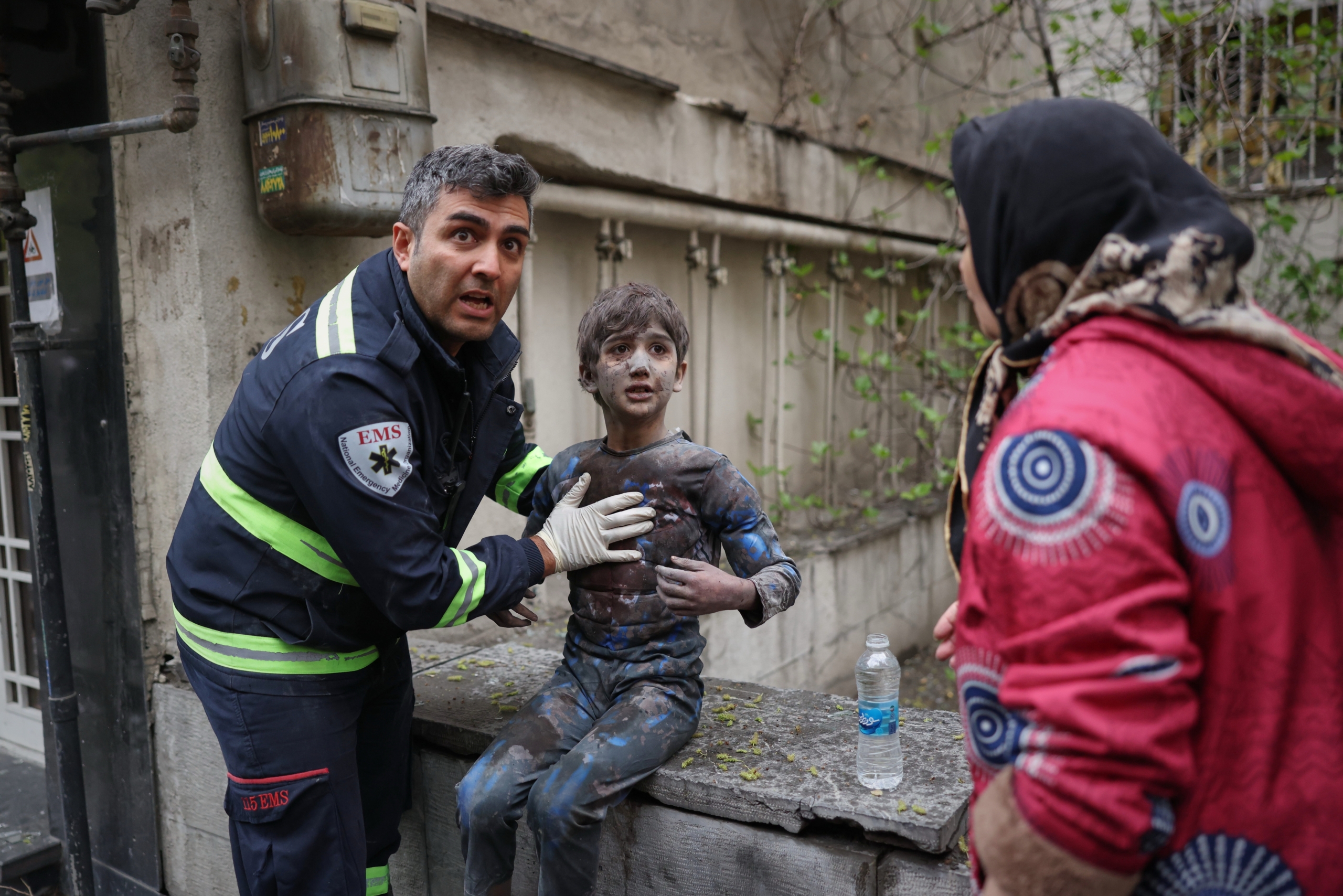
The rescue of the downed airman was an operation that “could have been ripped from a Hollywood movie,” Rachel Abrams said on The Daily. I found this to be an apt comparison, because the media fascination with the mission seemed to follow the logic of a blockbuster—specifically, one based on a comic book. In this moral universe, bad guys are bad, good guys are good, and shades of gray are nowhere to be found. There’s a common moment in superhero movies when the villain tears through the metropolis, destroying buildings and bridges and presumably killing hundreds of (mostly unseen) people. Then the camera zooms in on one telegenic civilian and their family, and the hero swoops in—at the last second!—to save them. The media’s selective empathy for a single downed airman, compelling as that story might be, seems to follow the same pattern: one life privileged at the expense of the seventeen hundred Iranian civilians killed so far in the US and Israeli war, according to a US-based human rights group, including at least two hundred and fifty-four children, and more than eighteen hundred people in Lebanon, according to authorities there.
Some might reasonably argue that the function of the press is to inform. But in this case, that seemed to come at the expense of another, more vital responsibility—providing perspective. The administration is waging a deeply unpopular war; has proved incapable of describing a stable set of objectives, let alone an exit strategy; has bombed a girls’ school and threatened further war crimes; and has routinely given news organizations conflicting accounts and told outright lies related to the conflict. In my view, the media has handled many of these concerns responsibly, so it was a shame to see them uncritically fall for the administration’s tale. As Krueger noted, the media seemed to swallow up every detail of the story from the very same official sources who in recent weeks have been factually unreliable.
Speaking at a press conference on April 6, before the temporary US-Iran ceasefire took effect, Trump—who is, after all, a TV president with a sharp instinct for story—added more details about the airman’s rescue. “He scaled cliff-faces, bleeding rather profusely, treated his own wounds, and contacted American forces to transmit his location,” Trump said. He also threatened an unnamed journalist with jail time for breaking news about the missing airman on Friday, April 3—before the White House wanted it out. “Hopefully we’ll find that leaker. We’re looking very hard to find that leaker,” he said. “We’re gonna go to the media company that released it, and we’re gonna say, ‘National security! Give it up or go to jail.’” None of the press in attendance questioned Trump further about that threat. But in the hours that followed, speculation centered on Amit Segal, an influential Israeli journalist with close links to the Benjamin Netanyahu government, whose newsletter is often republished in Bari Weiss’s Free Press and who is a vocal opponent of Palestinian statehood and claims of Israeli genocide in Gaza. Last Monday, Segal told his Telegram channel that the story of the downed weapons system operator “was first published here.” He later walked that back, telling the New York Post’s Caitlin Doornbos he was “not sure I was the first,” and “anyway—I will protect my sources.”
It’s unclear who reported the news first. What’s well established, though, is Trump’s long campaign of retribution against journalists and attempts to criminalize newsgathering. Two weeks ago, writing in this newsletter about January’s FBI raid on the home of Hannah Natanson, a Washington Post reporter, I looked at what it meant that the administration reportedly believed that Natanson—in addition to her source—violated the Espionage Act by possessing classified documents. “Charging a reporter under an arcane 1917 law would be another attempt by the administration to close the legal gap between reporters and sources when it comes to sharing information,” I wrote. On Thursday, federal prosecutors in that case urged a judge to overturn an earlier ruling barring the Justice Department from searching Natanson’s electronic devices.
Last week, the administration opened another front in its assault on reporting, when the Justice Department announced it had arrested and indicted Courtney Williams for allegedly sharing classified national defense information. Williams, who is forty, is a US Army veteran who told Seth Harp, an investigative journalist, that she endured sexual harassment and discrimination while working for the Army’s Delta Force. “My life became a living hell,” Williams told Harp; she now faces up to ten years in prison. Harp, who documented the alleged abuse in his book The Fort Bragg Cartel and in a Politico excerpt, said the indictment was “ridden with embarrassing factual errors,” criticized the FBI for “political theater,” and lauded Williams as a “brave and patriotic truth-teller.”
Harp, who was interviewed by CJR’s Carolina Abbott Galvão in January, also revealed that the FBI had been monitoring his phone. The DOJ’s press release mentioned ten hours of phone calls and more than 180 messages exchanged by Williams and Harp between 2022 and 2025. The administration appears intent on casting both journalists and their sources as villains, and seems to be hunting for their scalps. Harp, though, said he was confident the case will “fall apart upon careful scrutiny,” saying the indictment failed to point out which part of Williams’s account was classified. “Is it classified that many Delta Force operators and officers sexually harass and discriminate against women in the workplace?” he said. “Because that was the main thrust of Courtney’s testimony.”
Other Notable Stories …
- Last Thursday, senior US District judge Paul L. Friedman ruled that the Pentagon had violated his order, issued last month, to restore press access for journalists at the New York Times, finding that the Defense Department’s “interim” policy unconstitutionally sidestepped the earlier ruling. For CJR, Ivan L. Nagy wrote about the consequences of that policy—which saw the entire Pentagon press corps banished to an annex—and the rest of the Defense Department’s efforts to crack down on reporting. On Friday, the Pentagon asked Friedman to let it continue requiring escorts for journalists inside the building while it challenges the decisions in court.
- Last Wednesday, Israel’s military killed three more journalists in Gaza and Lebanon, according to the Committee to Protect Journalists (CPJ), which said at least one of the killings was a targeted attack. They were Mohammed Samir Washah, a correspondent for Al Jazeera Mubasher; Ghada Dayekh, a presenter with Sawt Al-Farah; and Suzan Khalil, a reporter and presenter on Al-Manar TV and Al-Nour Radio. CPJ’s regional director, Sara Qudah, said the organization “has consistently warned that without accountability, these attacks will continue to escalate, emboldening those who seek to silence independent reporting through violence.”
- On April 1, a federal appeals court upheld a preliminary injunction from last September that required the Department of Homeland Security to limit its use of force against journalists, observers, and peaceful protesters during Immigration and Customs Enforcement (ICE) raids in Southern California. A panel of judges wrote that an “avalanche” of evidence suggested that DHS was acting with “retaliatory intent.” It’s a win for the plaintiffs, including the LA Press Club, NewsGuild-CWA, and ACLU SoCal, which argued that attacks on reporters covering ICE protests were unconstitutional. In other news, NPR reported last week that ICE acknowledged it is using the spyware tool Graphite, made by Israeli company Paragon Solutions, to target fentanyl traffickers; Graphite has been used in the past to target journalists and civil society members.
- Shelly Kittleson, the American freelance journalist who was abducted by Kitaib Hezbollah, an Iraqi militia, in Baghdad in broad daylight, was freed on Tuesday after being held captive for a week. According to the Times, Kittleson was released in exchange for several imprisoned members of the militia. Writing in CJR earlier this month, Kiran Nazish, the founder of the Coalition for Women in Journalism, in which Kittleson has been involved since its inception, said that “Shelly’s commitment to journalism, I’ve come to find, is unconditional.”
- The Times’ John Carreyrou and Dylan Freedman published a piece last week claiming to have uncovered the identity of Bitcoin’s inventor, known as “Satoshi Nakamoto,” whom they describe as “one of our age’s great enigmas.” As part of the investigation, the reporters analyzed emails, court documents, and Satoshi’s historical posts on the Bitcointalk forum, finding that the clues pointed in the direction of Adam Back, a fifty-five-year-old British computer scientist. (Back denied the theory.)
- ProPublica journalists staged a twenty-four-hour strike on Wednesday, after more than two years of talks failed to yield a contract. About a hundred and fifty employees unionized in 2023 and have been negotiating ever since, the Times reported, with sticking points over wage increases, layoff protections, and workers seeking a say in how the investigative nonprofit uses AI. In March, 92 percent of members voted to authorize the strike. Jon Schleuss, president of the NewsGuild-CWA, said last week that ProPublica’s management is “refusing” to agree to “a just and fair contract.”
- And in The New Yorker, Vinson Cunningham wrote about Savannah Guthrie, coanchor of the Today show on NBC News, and the mysterious disappearance of her mother, Nancy, in Arizona, after a balaclava-wearing figure was seen on a security camera at Nancy’s home. Savannah Guthrie gave an interview about the apparent kidnapping on her return to Today. “They were narrating an awful and unresolved series of events,” Cunningham writes, “but also still doing the Today show—reassuring the audience by way of their softly displayed, endlessly professional command over the medium of television.”
Has America ever needed a media defender more than now? Help us by joining CJR today.