Sign up for the daily CJR newsletter.
Last Wednesday, a federal judge denied an asylum claim for the family of Liam Conejo Ramos, the five-year-old boy in the floppy blue bunny hat whose photo went viral when he was detained by Immigrations and Customs Enforcement (ICE) earlier this year. Liam, whose family is appealing the ruling, became the face of President Donald Trump’s immigration crackdown, and the detention facility where he and his father were held, Dilley Immigration Processing Center, quickly became the subject of increased scrutiny—and reporting—by ProPublica, New York, the Associated Press, the New York Times, the Texas Tribune, and the Marshall Project, among other publications.
The war in Iran, a brewing energy crisis, and fallout from the Epstein files have pushed immigration from the headlines since ICE agents killed Renee Good and Alex Pretti during protests in Minnesota in January. Early this month, Trump fired Kristi Noem, whose retaliatory and self-aggrandizing approach to running the Department of Homeland Security had grown increasingly controversial, and replaced her with Senator Markwayne Mullin. At his confirmation hearing last week, Mullin struck a milder tone, telling senators that his goal for the next six months will be that DHS isn’t “in the lead story every day.”
Immigration reporters, meanwhile, have stayed remarkably focused on illuminating the dark corners of the US immigration system. Detention centers have always been “black boxes,” but during the second Trump administration they have become especially “opaque,” as Shannon Heffernan, a reporter at the Marshall Project who has been covering Dilley, the country’s only family detention facility, told me. Retaliation, or at least the threat of retaliation, means sources held there are often afraid to talk. Like many DHS facilities, Dilley is remote and difficult to get into. “They choose these rural towns on purpose,” Emily Gogolak, who reported on Dilley for The New Yorker around the time it opened, said. Data on who is there and why often doesn’t add up: the Vera Institute, a nonprofit focused on criminal justice reform, notes that ICE often “obscures the breadth of its detention network by reporting limited, incomplete statistics, and only for a fraction of facilities.” The number of people in detention, including children, has increased sixfold since Trump retook office last year. Many journalists feel that while reporting on family detention has never been more difficult, it’s also never been more important.
Journalists on the immigration beat have navigated these challenges by thinking creatively: they have published letters and drawings from children in Dilley and used a drone to photograph a protest at the facility that would otherwise have been invisible to outsiders. Brenda Bazán, who photographed Dilley for the AP, told me she couldn’t fly the drone overhead because the area within the perimeter of the detention center itself is restricted. (Picture an “infinite line from the fence to the sky,” Bazán said. “I couldn’t cross that.”) So she made sure the drone hovered “right outside the fence,” as close to the imaginary line as she could get it. Many continue to rely on statistics from the Deportation Data Project, which gathers and publishes government data via public-records litigation.
When ICE arrested Estefany Rodríguez, a journalist who covers immigration in Nashville, on March 4, she too disappeared into the system. Though her lawyers knew where she was, they were only able to reach her ten days later. (She was also “barely” able to speak to her husband, according to court filings.) Rodríguez was eventually granted bond; she was released on Thursday. (A separate habeas case is ongoing in federal court.) When she finally spoke to her legal team, she cracked open the black box. She recounted being in isolation for five days after being searched for lice—even though a woman who combed out her hair didn’t find anything. Later, she was forced to strip naked, she said, and an officer poured a “chemical liquid” she believed to be “something used to clean floors” over her scalp.
Information, even in the most tightly controlled settings, has a way of getting out. Much of the journalism published about Dilley in recent weeks outlines conditions like those Rodríguez described, which were included in a recent court filing. ProPublica noted that kids found “worms and mold” in their food; the AP recounted a detainee’s suicide attempt; the Times told the story of a toddler who was denied healthcare for weeks. “Why is this happening to us?” an eighteen-year-old girl asked, according to the Marshall Project. (In a statement, DHS broadly categorized these claims, naming the Times story in particular, as “FALSE.”)
Dilley, which is managed by a private prison operator called Core Civic, was inaugurated during the Obama administration, in December of 2014. Seven years later President Joe Biden closed it, but it resumed operations soon after Trump took office for the second time, in 2025. For Gogolak, who was one of the first to report on Dilley, access was already a problem. Though she no longer covers immigration, she has continued to follow the story. Over the years, she has found that Dilley, a former agricultural hub once known for growing as much as twenty-five million pounds of watermelon a year, always “reappears in the public consciousness” somehow.
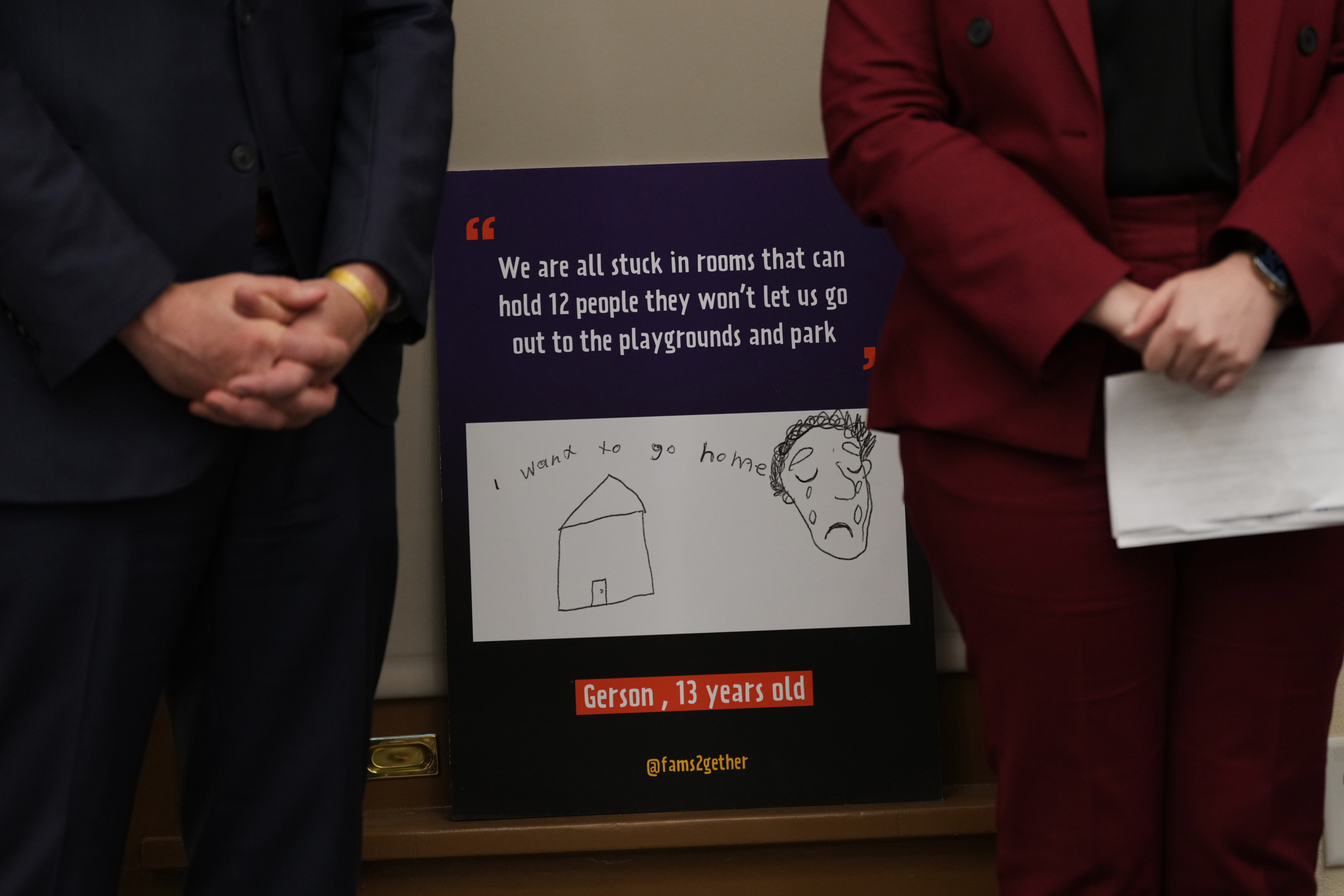
Mica Rosenberg, an investigative reporter at ProPublica, started reporting on Dilley in late 2025. She received mixed messages when she tried to organize a press visit, so when a spokesperson for ICE told her that she could go in as a visitor if the detainees she was talking to agreed, Rosenberg figured she should “just go for it.” While Rosenberg, unlike many reporters, saw the inside of the center, her work lets sources speak for themselves. Drawing from letters written by kids at Dilley, her story documents the detainees’ day-to-day concerns: waiting to get medicine when they are sick, feeling bored, not understanding why they are there, wanting to go home. In interviews, children told Rosenberg they missed McDonald’s Happy Meals, their favorite stuffed animals, and their dogs.
The Trump administration often says it is arresting “the worst of the worst,” but “when people see the drawings or see the videos, it doesn’t fit with what a lot of people in the country might be behind, which is arresting violent criminals,” Rosenberg said. For her piece, she talked to a Venezuelan child who was picked up outside a hospital in Portland, Oregon (her parents had applied for asylum), as well as with a teenager who was sent to Dilley after her father was charged with involvement in an anti-Semitic attack in Boulder, Colorado, among others. Whatever the circumstances of these kids’ arrests, it’s hard to argue that a child is a danger to society; reporting on family detention shows that “there’s a stark difference between what the administration says is their priority and who is being detained there,” Rosenberg told me.
Valerie Gonzalez, who has covered Dilley for the AP and likewise used letters and drawings as part of her reporting, told me that the method helped her talk to kids in detention without “retraumatizing” them. Interviewing adult detainees posed its own challenges. “There were some women who were just flat out not going to talk, and I told them, ‘That’s fine, I completely understand,’” she said. “That’s when I heard that they felt that they had been threatened.” A source told Gonzalez that members of the staff at Dilley had said that if detainees spoke poorly about the conditions at the center, there would be a report filed that could negatively affect their immigration proceedings. “If you are in that position, who are you to distrust what they are saying?” Gonzalez said.
It’s possible that the more light journalists shed on what’s happening inside Dilley, the harder it will be to report on it. A few weeks ago, ProPublica published a follow-up to its first story, chronicling a clampdown at the detention center. The piece describes guards going through a detainee’s room: lifting up mattresses, opening drawers, rifling through papers. Their reasoning soon became clear enough: among the list of items seized were crayons and colored pencils.
Other Notable Stories …
- On Friday, US District Court Judge Paul Friedman ruled that the Pentagon’s restrictions on press outlets violate the First and Fifth Amendments, siding with the New York Times, which sued the Defense Department in December. The restrictions, which were introduced in October, prohibited journalists from soliciting information not authorized for release by the Pentagon, even if it was unclassified. (CJR’s Ivan L. Nagy, who has been covering the saga from the start, wrote about the lawsuit early this month.) The Times argued that the policy would “deprive the public of vital information about the United States military and its leadership.” Friedman agreed. “Those who drafted the First Amendment believed that the nation’s security requires a free press and an informed people and that such security is endangered by governmental suppression of political speech,” he wrote in his opinion. Later that day, Sean Parnell, the Pentagon spokesperson, said on X that the Trump administration plans to pursue an “immediate appeal.”
- On Thursday, the Federal Communications Commission approved Nexstar’s 6.2-billion-dollar deal to acquire Tegna, which will push its control of local stations above the existing federal cap. At least eight states, including New York and California, are suing to block what Letitia James, New York’s attorney general, called an “illegal merger” that threatens the integrity of local coverage. For CJR, Kyle Paoletta previewed this decision in October, noting that Brendan Carr, the chair of the FCC, was using the public airwaves as a means to “force the nation’s broadcasters into fealty to Donald Trump.”
- On Friday, Bari Weiss, the editor in chief of CBS News, and Tom Cibrowski, the network’s president, sent a letter to employees announcing layoffs. They framed the decision as a strategic pivot: “It’s no secret that the news business is changing radically, and that we need to change along with it,” they wrote. “That means some parts of our newsroom must get smaller to make room for the things we must build to remain competitive.” The layoffs come amid a broader pattern of job cuts at Paramount, CBS’s parent company, since its takeover by David Ellison’s Skydance.
- Last week, the Wall Street Journal’s Alexandra Bruell profiled Patrick Soon-Shiong, the billionaire who in 2018 bought the Los Angeles Times. Soon-Shiong, who is pursuing a public offering for the media company, told Bruell he wants to turn it into a Murdoch-style family affair. Neither of his children, however, is currently involved. (His daughter Nika Soon-Shiong is the publisher of Drop Site News.) Meanwhile, Julia Turner, a Los Angeles Times alum, launched LA Material, a news outlet “animated by an abiding obsession with what makes this city great and what’s at stake when it falters.” An independent nonprofit, LA Material is owned by its founders, founding employees, and a group of investors.
- Following devastating cuts at the Washington Post in February, Robert Allbritton’s digital publication NOTUS—News of the United States—has announced that it will hire a handful of well-known former Post journalists. The Guardian’s Jeremy Barr reported that the company plans to double its staff of fifty by the end of the year, “a decision that Allbritton said was ‘precipitated’ by the Post layoffs, which sped up the company’s longstanding plans to grow.”
- Last week, the Kansas Reflector reported that a committee in the Kansas State Legislature is considering a bill that would criminalize “unlawful approach of a first responder,” which could affect journalists reporting on emergencies and breaking news. Violations could be punishable by up to a thousand dollars in fines and six months in jail.
- Lisa Nandy, the UK culture secretary, announced plans to grant BBC leadership’s demand for a permanent charter, a pivotal step toward securing the broadcaster’s integrity amid political pressure. For now, the charter must be renewed every ten years; the current one expires in 2027. As Reform UK, the Nigel Farage–led far-right party that is highly critical of the BBC, gains ground ahead of the next general election, the move could save British public media from the fate of the Corporation for Public Broadcasting and US Agency for Global Media.
- And in a New Yorker piece published in this week’s print edition, David Remnick, the magazine’s editor, grapples with what the Pentagon policy—as well as other attacks on the press—mean in light of the war in Iran. “The cruellest irony,” he wrote, “is that the President who addresses the Iranian people in the language of liberation, urging them to throw off the yoke of a regime that has brutalized them for decades, is the same man who threatens American journalists with treason charges and tries to strong-arm broadcasters into subservience.”
Has America ever needed a media defender more than now? Help us by joining CJR today.