Sign up for the daily CJR newsletter.
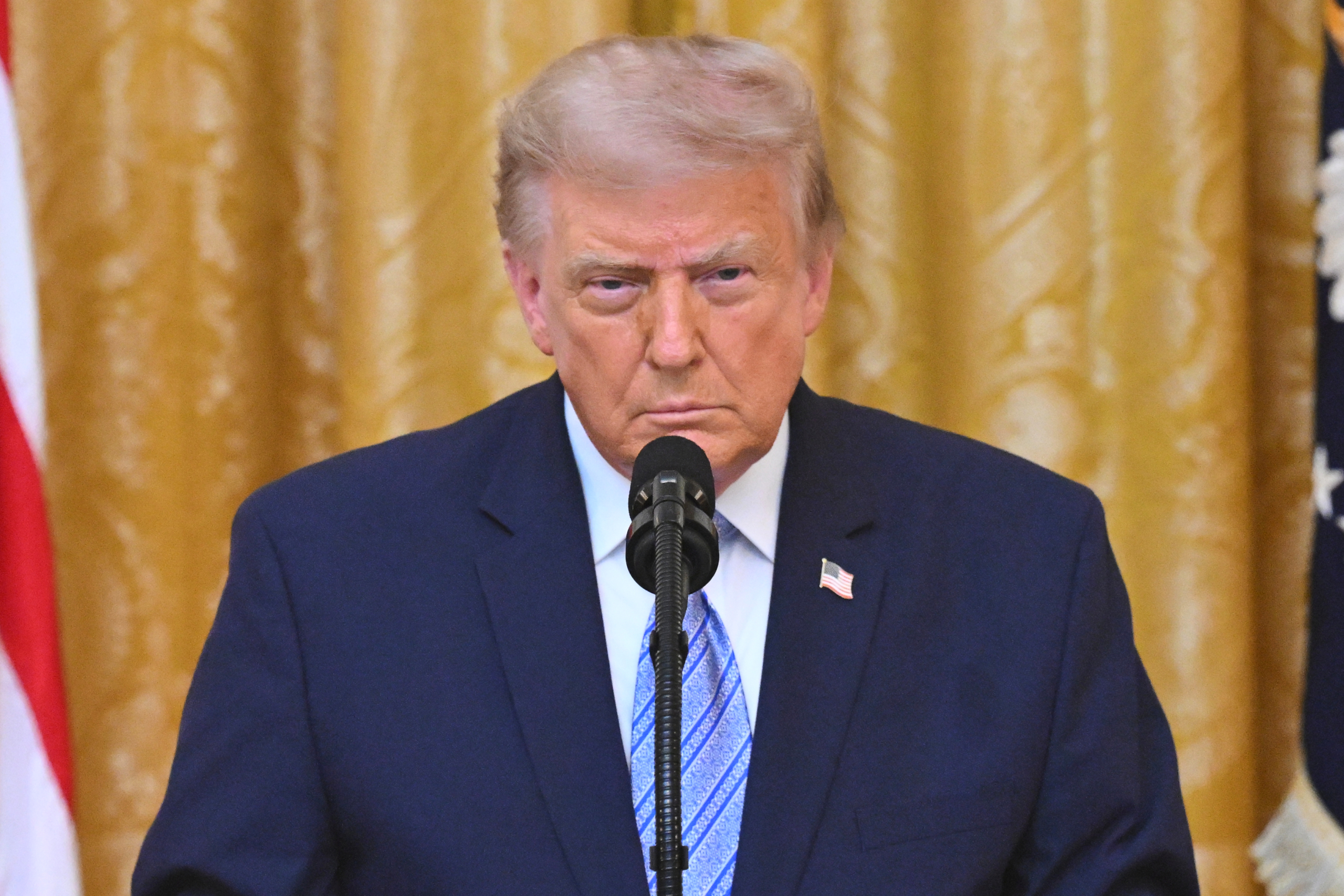
On May 15, as Donald Trump and his entourage flew back to the United States from a state visit to China, the president ambled to the back of Air Force One for a gaggle with the traveling press corps. David E. Sanger—the New York Times’ White House and national security correspondent—stood face to face with Trump, his phone stretched up to just below the president’s mouth, appearing to record his words. Sanger asked about the war with Iran. “What would the use be of repeating the bombing? You did it for thirty-eight days, and you did not get the political changes in Iran—” Trump jumped in: “No, I got, I had a total military victory,” he said, touting his administration’s supposed successes. Then he leaped into a tirade against the press. “I actually think it’s sort of treasonous what you write,” Trump concluded. “And you should know better, David. You know better. Your editors tell you what to write, and you write it, and you should be ashamed of yourself. I actually think it’s treason.”
Over the past decade, Trump has repeatedly suggested that people he views as his adversaries—journalists, politicians in Congress and the White House, federal bureaucrats, and activists, to name a few—are traitors to the nation. Trump has always had a hard time distinguishing between the national interest and his own whims, so it’s perhaps no big shock that he routinely confuses dissent with treason. But these pronouncements have seemed increasingly common lately. Last fall, after a group of Democratic lawmakers posted a video reminding military servicepeople that they can refuse illegal orders, Trump accused them of “SEDITIOUS BEHAVIOR, punishable by DEATH!” (The administration’s attempt to bring a federal indictment against the lawmakers failed, and was eventually abandoned.) In March, the White House, in an official release, accused CNN of trying to “undermine our decisive victories” in the US-Israeli war on Iran, and Trump posted on Truth Social that some outlets “should be brought up on Charges for TREASON for the dissemination of false information!” Last month, he lashed out at the Times again—for an analysis that explored how the decision to wage the war had changed very little geopolitically—alleging “TREASONOUS” stories and warning: “I will be adding all of their false and ridiculous reporting to my multi Billion Dollar lawsuit against them. They are Criminals!” Trump has written or reshared social media posts featuring the word “treason” more than fifty times since 2016, according to Roll Call. These comments are often erroneous, legally incoherent, or delivered in clumsy asides during speeches, but they tend to be united by a sense of rage at anyone appearing to undermine Trump’s personal authority. “There is no more serious charge a commander in chief can make against an independent news organization,” A.G. Sulzberger, the publisher of the Times, wrote after Trump called the paper treasonous during his first term. As Margaret Sullivan put it in The Guardian recently, this is “the language and the strategy of authoritarian states.”
To point out the obvious, none of the things Trump has described as such come close to amounting to treason. To prevent abuse by a would-be despot, the framers of the Constitution sketched a very narrow definition of the term—which is the only crime explicitly defined in the document—as levying war against the United States, “or in adhering to their Enemies, giving them Aid and Comfort.” But that does not make Trump’s constant drumbeat of accusations something we should normalize or ignore. One of Trump’s goals, as some observers have noted, is to bully, threaten, and shame news organizations with enough ferocity that they soften their scrutiny. (In some cases this appears to have worked; CBS News and its parent company, Paramount Skydance, have sought to curry favor with the Trump administration.) The cries of treason are also part of Trump’s long-standing push to delegitimize the independent press. “You know why I do it?”—insult the press, that is—“I do it to discredit you all and demean you all so when you write negative stories about me, no one will believe you,” Trump reportedly said in 2016 to Lesley Stahl, the 60 Minutes correspondent, according to her telling. And then, of course, there is Trump’s tendency to bruise easily from bad publicity, stretching back to his days as a real estate developer and tabloid darling in the eighties.
Yet Trump’s claims of treason, to me, stem from a more sinister impulse—and represent more serious offenses—than his day-to-day abuse. Accusing an opponent of this highest of crimes, or smearing them as a traitor, is an attempt to enforce a particular vision of political belonging. By deploying these terms, a speaker carves a wound into the body politic, defining who is part of it on one side, and who is banished as disloyal on the other. By branding journalists as traitors, Trump is telling his base that the press—instead of being a load-bearing pillar of America’s ongoing experiment with democracy—is in fact a fifth column, an enemy within, a parasite that must be purged. In this way, Trump’s exclusionary rhetoric helps reveal the violence that has always been necessary to tie his political movement together. As the intertwined threads of the MAGA coalition loosen over Jeffrey Epstein, the war in Iran, the rising cost of living, and questions of succession, Trump’s language has become increasingly martial, as he tries to keep his base from unraveling.
On May 15, Sanger, following Trump’s rant at him on Air Force One, went on X and reshared a post from @NYTimesPR—written in the direct, rapid-response style that has become characteristic of that account in recent months—which quoted Charlie Stadtlander, a Times spokesperson. “Reporting isn’t treason. It’s foundational to a free press and the work that America’s founders wrote the First Amendment to protect,” Stadtlander had written. “We will continue this important, constitutionally protected work.”
Other Notable Stories …
By Jem Bartholomew
- The White House formally asked broadcast networks to air a prime-time speech on Thursday in which Donald Trump repeated baseless lies that he won the 2020 presidential election and sought to sow doubt about the integrity of US elections ahead of the midterms. NBC and ABC refused to air his remarks live, prompting Trump, in his speech, to threaten the broadcasters and call for their licenses to be revoked, even though national networks, unlike local ones, are not licensed by the government. “Overall, the address was taken seriously in partisan pro-Trump media circles, while it was treated skeptically everywhere else,” Brian Stelter, of CNN, wrote. The Times reported that the speech landed “with a whimper,” even among Trump’s Republican colleagues.
- On Thursday, US district judge Arun Subramanian granted a request from the Times to postpone the appearance of five journalists who had been subpoenaed by the Trump administration to testify before a grand jury—in a deeply disturbing case that I wrote about for CJR last week—pending a hearing on a motion to quash the subpoenas, Status reports. It means the five journalists will not, for now, be forced to testify about their reporting or confidential sources related to coverage of security concerns about a plane Trump received as a gift from Qatar. In other news on Thursday, a federal appeals court ruled that the Pentagon could temporarily require escorts for journalists in the building. For more on the case, see Ivan L. Nagy’s timeline for CJR on the Pentagon’s push to silence reporters.
- The US government is “considering participating” in Donald Trump’s civil lawsuit against the BBC, the Financial Times reported last week. The broadcaster has argued that the case—which relates to a documentary on Trump and the Capitol riots of January 6, 2021, that I wrote about for CJR in November—should be thrown out, saying there is no evidence the documentary was viewed in the US. (The US government would be seeking to join as an interested party, not as a plaintiff, according to the FT.)
- Last week, the Committee to Protect Journalists condemned the Trump administration’s imposition of new visa restrictions on international correspondents, replacing open-ended rules that have been in place since 1985. “Under these restrictions, the Trump administration has moved to—yet again—deny access based on its individual policing of a journalist’s reporting,” CPJ’s Jose Zamora said in a statement. CPJ also expressed alarm at the two-hour interrogation of journalist Max Blumenthal by Customs and Border Protection agents on July 11, after he returned from a reporting trip to Iran. “It was very clear that what I was doing was journalistic,” Blumenthal told CPJ.
- Brendan Carr, the chairman of the Federal Communications Commission, said on Wednesday that the FCC will vote next month on whether to repeal current rules that prohibit a single company from reaching more than 39 percent of TV households, enabling even further consolidation of local TV station ownership. The FCC has three commissioners, two Republicans and one Democrat, so the plan is almost certain to pass. It would represent “a long-sought victory for media moguls who are aligned with President Donald Trump and the Republican Party,” according to CNN.
- And in Singapore, Bloomberg News lost a landmark libel case related to its reporting, in December of 2024, on the country’s wealthy elites, including two government ministers, acquiring high-end properties through opaque trusts. The ministers sued Bloomberg and a reporter for the outlet for defamation; they did not dispute the accuracy of the article, but claimed they had been portrayed—with malice—as involved “in a shady deal with the possibilities of money laundering.” Singapore’s libel laws make it much easier for public figures to sue news organizations than in the US. “We argued at trial that our reporting was accurate and served an important public interest, and we continue to believe that the ministers have imposed an extremely strained meaning on what was a solid story,” John Micklethwait, Bloomberg’s editor in chief, said in a statement.
Has America ever needed a media defender more than now? Help us by joining CJR today.