Sign up for the daily CJR newsletter.
Toward the end of The Social Reckoning, Aaron Sorkin’s new film dramatizing the run-up to, and aftermath of, the Wall Street Journal’s “Facebook Files” in 2021, Jeff Horwitz, a Journal reporter played by Jeremy Allen White, meets with a brash company press officer, played by Billy Magnussen. Horwitz arrives with a notebook full of questions. He is hoping to hold the company to account for the harms it has perpetrated against individuals and democracy at large. “Jeff,” the PR flack tells him, “we’re twice as big as the biggest country on earth. We’re not frightened of Congress. We’re post-government around here.”
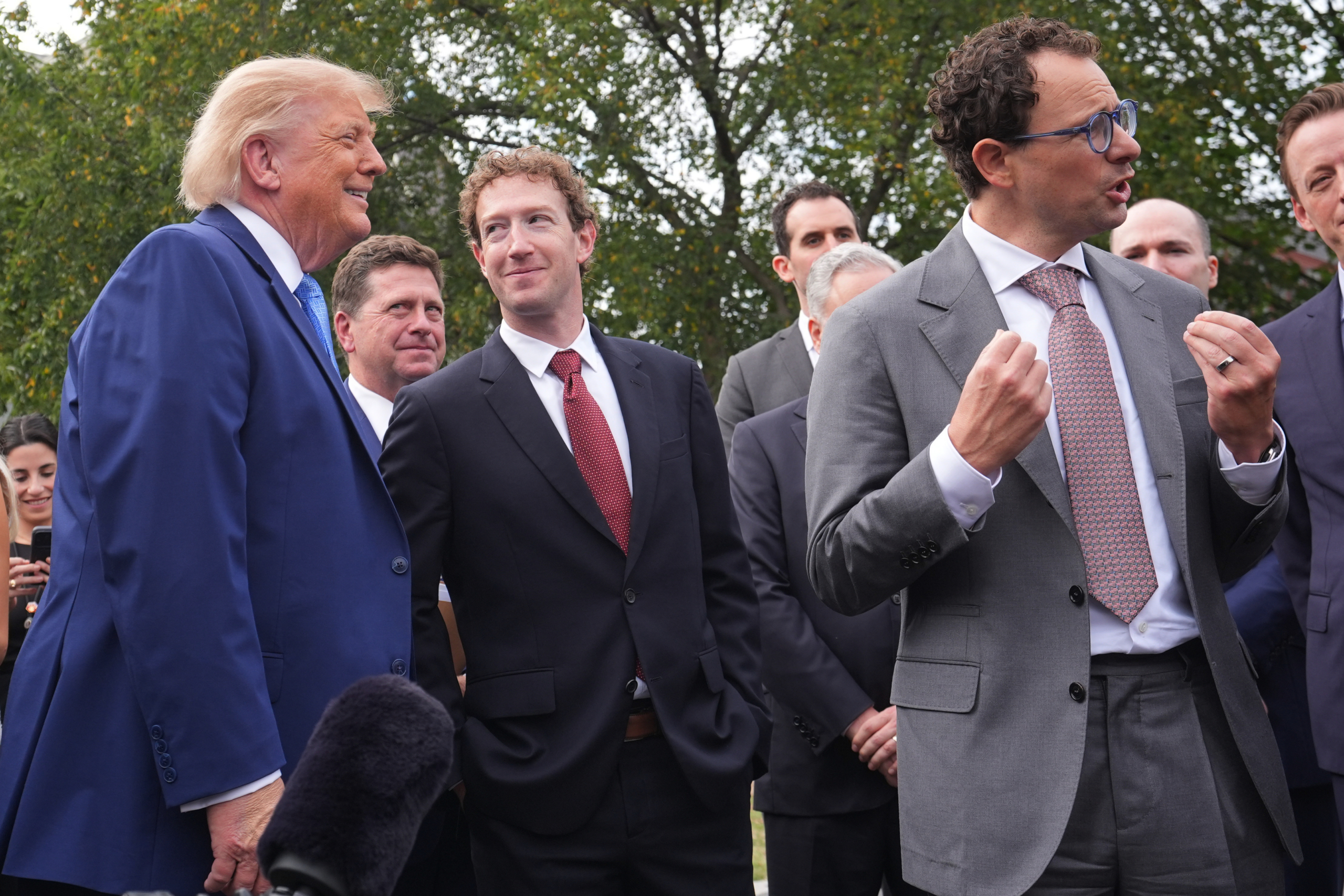
If that attitude of disdain for accountability sounds unnervingly familiar, it might be because we now hear it every day, beamed onto TVs and phone screens, from the man residing in the White House. Donald Trump has made animosity toward accountability central to his governing style—he attacks the legitimacy of the courts, of political opponents, of elections, of the press—and has enabled this attitude to spread across America’s most powerful institutions. Whether it’s elected MAGA politicians, the national security apparatus, or the tech moguls of Silicon Valley, a hostility to answering questions—and an interpretation of journalistic scrutiny as hostile or “un-American”—is becoming normalized among a cohort of the country’s most powerful leaders. Trump, who gathered tech CEOs at the White House on September 29 for a summit on artificial intelligence, made this plain when a reporter asked him whether there would be “no guardrails” on AI. “There should be tremendous self-regulation,” he said. The message was clear: leave us elites alone to govern ourselves.
That ethos could be felt on Saturday, when a spokesperson for the Department of Justice said that the agency is investigating whether the White House TV press pool—CNN, ABC, CBS, Fox News, and NBC—had recently violated federal antitrust laws, specifically the Sherman Act, which prohibits businesses from entering into anticompetitive agreements. “Officials from the Justice Department contacted networks on Friday and demanded communications and materials related to the White House TV pool,” the Times reported, citing six people with knowledge of the investigation. (Kyle Cheney, of Politico, pointed out on X that Laura Loomer, the far-right influencer who has often had the ear of Trump, had called for an antitrust investigation into TV networks for colluding “to refuse to cover President Trump” in September.) Seth Stern, the chief of advocacy at the Freedom of the Press Foundation, called the investigation “nonsense,” adding that “antitrust law has long recognized First Amendment exceptions even when there is anticompetitive impact.”
The investigation seems to be a clear case of retaliation against journalistic institutions—a politicized use of a branch of the federal government, directed even against Trump’s beloved Fox News—following the TV pool’s defiance of the president in recent weeks. In response to Trump’s September 18 announcement that he was casting out CNN, MS Now, and Politico from the White House grounds, the TV pool initially refused to air any footage, and called for the reinstatement of their colleagues. For a number of days in late September this starved Trump of TV coverage from the pool; my CJR colleague Susie Banikarim called the move a “striking and heartening show of solidarity.” On September 24, Judge Timothy J. Kelly, of the US District Court for the District of Columbia, issued a temporary order forcing the administration to restore access for CNN, MS Now, and Politico to the White House for two weeks; after hearing arguments last Thursday, Kelly is expected to issue an update in that case by Tuesday.
We have seen the same hostility to journalistic scrutiny at the Pentagon, where the Trump administration pushed long-standing members of the building’s press corps out, issuing draconian requirements that essentially banned reporting. The Department of Defense (or War, as Pete Hegseth has demanded it be called) invited sycophantic right-wing media outlets in for favorable coverage of America’s heroic quagmires abroad. But even then, as my CJR colleague Ivan L. Nagy has covered, press conferences are rare—and, amid more legal back-and-forth, the Pentagon remains reporterless. As the fight over access continues, the Pentagon has been administering polygraph tests to root out leakers.
Of course, it is not just the federal government that appears to be gripped by a mindset that press accountability is oppressive. For years, the tech companies of Silicon Valley have acted with impunity and expected to get away with it—and in many cases have done so. This is partly what The Social Reckoning explores. The movie, absent the fizzing tension and crisp dialogue of its predecessor, The Social Network, is unlikely to sweep the Academy Awards. But it nevertheless tells a timely story about Frances Haugen, a young engineer at Facebook, and her journey to becoming a whistleblower who battles against corporate opacity and the impunity it encourages. Haugen, played by Mikey Madison, has seen the destructive fallout of the company’s algorithms from inside. After deciding to blow the whistle, she downloads tens of thousands of internal documents, and in the end testifies before the Senate. With the help of Horwitz, she pulls up the blinds and lets the light flood in.
I watched The Social Reckoning at a screening in London attended by people from the worlds of media and tech. Discussions couldn’t help but note that we live in a new era of tech reporting now. The AI age has led to an even greater degree of information asymmetry, or lack of knowledge about what goes on inside leading tech firms. (Even company engineers might not fully grasp the capabilities of the latest AI models.) Just before the movie played, the theater aired a recorded message from Sorkin: “As this story shows, journalists, data scientists, politicians, and everyone in between have a role to play in getting these stories out and trying to shape the world for the better,” he said. He also told viewers: “I hope the film makes you a little angry, in the right way.”
There is much to be angry about: an aggression toward the very concepts of transparency and accountability—be it from the federal government, the national security establishment, or the tech companies that control our online infrastructure—has taken root among American elites. Often, this manifests as disdain for, or retaliation against, the free press, as in the DOJ investigation announced over the weekend. The trend we’re observing is profoundly undemocratic. “Trump is weaponizing the DOJ to pressure the networks he calls the ‘enemy of the people’ to stay at the White House,” as Stern put it. “It’s a weird way of telling the press how much he missed them.”
Other Notable Stories …
By Jem Bartholomew
- Last Monday, Fox News announced that Karoline Leavitt, the former White House press secretary, will join the network as an on-air contributor, starting November 1. When Leavitt, twenty-nine, announced her departure in August, I wrote that she was “leaving relations between the executive branch and the Fourth Estate far worse than she found them.” On Friday, Trump announced her replacement: Katie Zacharia, forty-one, a conservative commentator who has been a communications adviser to Trump Media and Technology Group (TMTG), the owner of Truth Social. “She has an unblemished record of support, and has been a loyal and brilliant supporter, right from the beginning,” Trump said.
- On Thursday, Christina Assi, a Lebanese journalist, called on the European Union to hold Israel to account for crimes against journalists in Lebanon and Gaza, as part of the upcoming meetings of the Foreign Affairs Council and European Council. Assi was gravely wounded by Israeli forces on October 13, 2023, while reporting on Israeli shelling of southern Lebanon, in what the Committee to Protect Journalists (CPJ) describes as a “targeted Israeli attack” that also killed Issam Abdallah, a Reuters videographer, and wounded five other journalists. “Israel has claimed this was a ‘mistake’ and that the Israeli military believed we were ‘Terrorists.’ But we were visibly marked as ‘Press,’ openly working on a hill, and a drone was monitoring us,” Assi wrote. “I call on you, the leaders of Europe, to use every political, legal, and diplomatic tool at your disposal to end Israel’s impunity.”
- Paramount Skydance completed its takeover of Warner Bros. Discovery last Tuesday, establishing a new company called Skydance that will control both CBS News and CNN. (I wrote about the merger for this newsletter last week.) David Ellison, the chief executive of Skydance, persuaded Mark Thompson, the chief executive at CNN, to remain in his post, the company said on Monday. In a CNN company town hall, Ellison told Anderson Cooper that he believes “deeply in journalism,” according to Brian Stelter, also of CNN. Ellison added that he did “not want to politicize the company.” He also appeared to reference a dinner he hosted “honoring” the Trump White House earlier this year: “We were in a transaction review process. But with that said, we are now turning that page.”
- On Saturday, the Washington Post published an interview with Abdelrahman Mansour, cofounder of an independent Egyptian news site, Matsadaash, which saw all six of its journalists arrested in September over accusations of spreading misinformation. “They were forcibly disappeared for five or six days,” Mansour said, adding that the detained journalists alleged “they were treated badly, tortured, victimized.” Last week, Egyptian authorities announced terrorism charges against the six people, according to Le Monde. Of the hundred and eighty nations on the Reporters Without Borders World Press Freedom Index, Egypt is ranked one hundred sixty-nine. Over the weekend, protests were planned in Cairo in support of the journalists.
- And to mark the fortieth anniversary of its first issue, Spy magazine will have a brief new life on Substack. For about a month it will post articles from the archive, all of them featuring Trump, whose “lies and boasts and gangsterism and stupidity” the magazine covered “meticulously,” it said. Steven Kurutz, writing for the Times, said that Spy’s “tone—urbane, mischievous and sometimes venomous—set it apart from the usual journalistic fare.” Its first post featuring Trump, on October 5, revived an article from Spy’s first edition: “The Ten Most Embarrassing New Yorkers.”
Has America ever needed a media defender more than now? Help us by joining CJR today.