

Sign up for the daily CJR newsletter.
At the end of The War Room, the documentary on the media and strategy team behind Bill Clinton’s 1992 bid for the White House, George Stephanopoulos, the communications director, takes a call. It is Clinton, on the evening when people will stop calling him governor of Arkansas and start referring to him as president-elect of the United States. The viewer can’t hear him, but he seems to want advice on an upcoming speech. “We really want you to say whatever you wanna say tonight, but you just gotta be careful about being too programmatic,” Stephanopoulos, who is now the host of ABC’s This Week, says, suggesting that Clinton position himself as a New Democrat and lean into patriotism. “But, you know, just speak from your heart tonight, that’s all that matters,” Stephanopoulos tells him. “Say what you want to say. This is your night.”
After a decade of Donald Trump’s breathless, impulsive rhetoric, it can be strange to remember that, not so long ago, the messaging of politicians and presidents was so stage-managed that it sometimes seemed as if the spin doctors were really in charge. The idea of Trump taking advice, let alone direction, from a communications strategist seems faintly absurd. His whole political style is antithetical to strategy; listening to one of Trump’s meandering rally speeches can make a night of improv feel structured. (“My speeches last a long time because of the weave, you know,” Trump told Joe Rogan in 2024, during a three-hour demonstration of the form. “The weave is very, very important. Very few weavers around.”) This makes the job of White House press secretary in the Trump era an odd one. Katie Zacharia—who was ousted on Friday after just five days in the post, slashing in half a record set by Anthony Scaramucci, who served ten days as White House communications director in 2017—acknowledged as much in her first and only press briefing. The president “is his own best spokesperson and will absolutely be leading the way with that,” she said.
If Trump is not hiring someone for an ability to craft a communications strategy, handle relations with journalists, or plant favorable media talking points, what exactly is a press secretary for? He is drawn to people with a certain skill set: kiss-the-ring fealty is high on the list. “She has an unblemished record of support,” Trump said, in an October 9 post on Truth Social announcing Zacharia’s hiring, “and has been a loyal and brilliant supporter, right from the beginning.” A willingness to repeat MAGA’s foundational untruths, no matter how outlandish, is another key qualification. (Zacharia made a bright start on that score, asserting on Tuesday that rally attendance “is at record highs as enthusiastic, hardworking Americans are lining up and packing arenas to support President Trump and Republicans,” despite C-SPAN footage that showed dozens of empty seats at a recent event in Texas.) But it’s not enough to lie. One must do so convincingly, and without hesitation. “You gotta lie like a machine-gunner at a turret in that job,” Scaramucci, who has been doing a comeback tour of TV networks in recent days, told CNN. “And Karoline Leavitt was really good at that. She lied with great impunity and great enthusiasm.” That, he implied, is where Zacharia failed.
This should not need to be said, but for some reason it does: all of Trump’s requirements undercut the purpose of a White House press secretary. The press secretary is the first point of contact for journalists seeking answers about what the federal government is doing and how it is spending people’s tax dollars. Zacharia, who was previously a senior communications adviser for Truth Social, the social media platform of which Trump is the largest stakeholder, came to the president’s attention during guest appearances on Fox News, the Wall Street Journal reported. (He apparently wanted Maria Bartiromo, the ousted Fox News host I wrote about last month, for the role, but according to Axios, she demurred.)
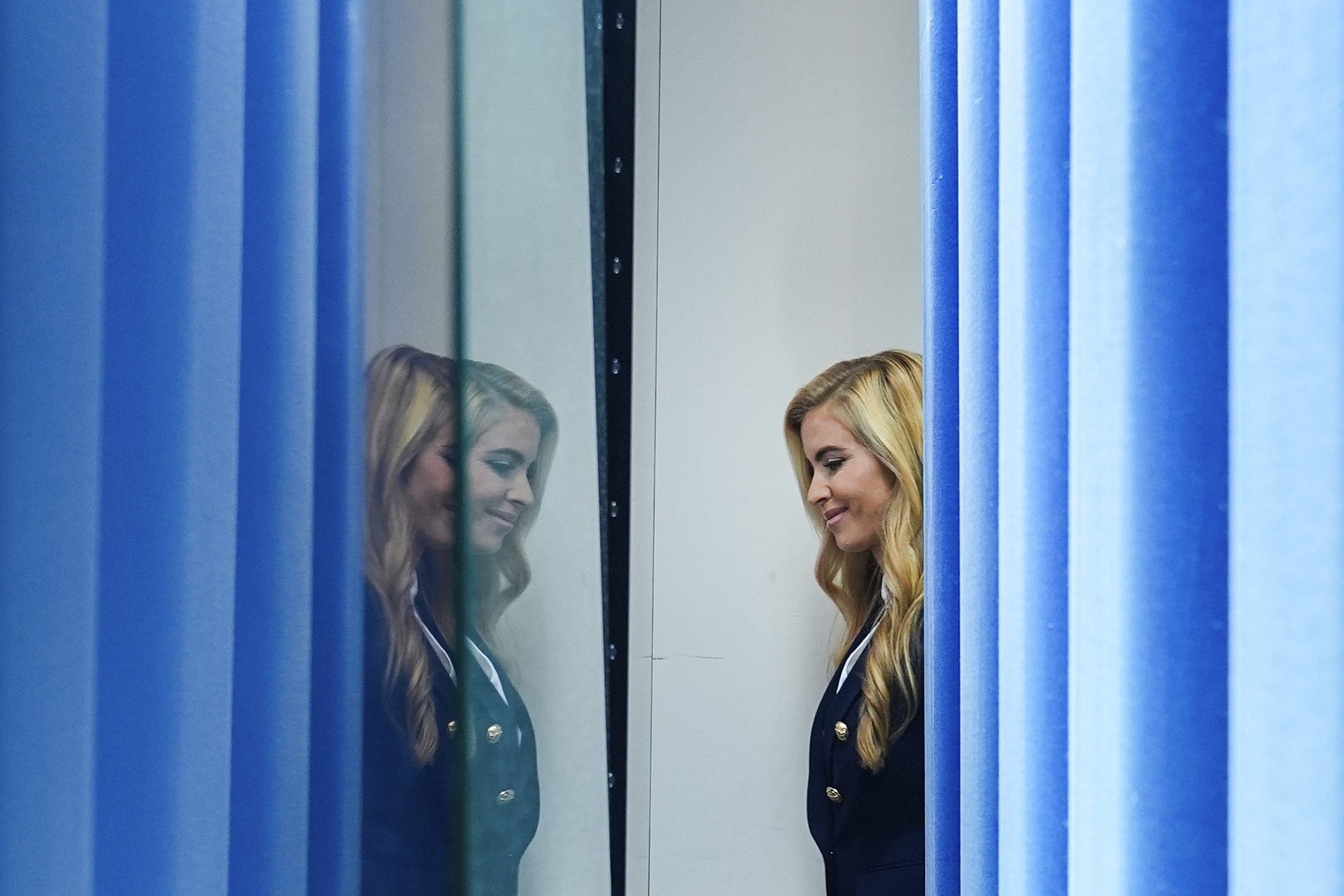
Zacharia said she arrived in Washington from Los Angeles on October 8, met with Trump the next day, and was hired on the spot. She started work on Monday, October 12. At her first press briefing, the next morning, which lasted fourteen minutes, she appeared anxious and unprepared. Her delivery was wooden. She may have read aloud from the stage directions in her prepared remarks. She took three questions, all from right-wing outlets, then departed. “I am just going to start tonight by saying something that I never thought I would say,” Jen Psaki, who formerly held comms roles in the Obama and Biden White Houses, said afterward on MS Now: “Karoline Leavitt, wherever you are, I miss you.” (Psaki and a handful of other former White House press secretaries did not respond to my requests for comment over the weekend.)
On Tuesday morning Judd Legum, of the Substack Popular Information, ran an article about how, despite being “identified on screen as a lawyer during at least eighteen appearances on Fox News since March 2025,” there was “no evidence that Zacharia ever passed a bar exam or has been admitted to practice law in any state.” Later that day, when a reporter asked Trump in which state she had passed the bar, Zacharia, standing nearby, answered: “When I moved to China.” Trump looked confused. (She later claimed to have misunderstood the question.) On Thursday morning, the Journal reported that she had failed the California bar exam in 2011, citing a person with “direct knowledge of the matter.”
A bruising interview with Sean Hannity, of Fox News, on Thursday evening seemed to seal Zacharia’s fate. Hannity’s tone was frostier than most would have expected, like a disappointed parent speaking to a child who has flunked a test. “You went to Pepperdine but did not pass the bar exam, correct?” Hannity asked. “Why didn’t you just say, ‘I never practiced law’?” At the start of the segment, Zacharia had a broad smile; by the end she did not. On Friday, Trump blamed her wobbles on the press behaving “pretty nastily.” He told reporters: “Just generally the media has been very rough. She was on Sean Hannity last night, and Sean was a little bit tough.” Later that day, Zacharia was ousted. According to one tally, she left her job having said fewer than two thousand official words.
Does any of this really matter? Some of the coverage from the White House press corps in recent days—Who supported and who undermined Zacharia? What role did Susie Wiles play in her hiring and firing?—has felt a little beside the point. Yes, the past week has been reminiscent of Trump 1.0 (chaos! wacky characters! news cycles that spark up and burn out in a matter of hours!), but we do not live in that world anymore. Over the weekend, CNN’s cameras were again barred from Air Force One, part of Trump’s ongoing efforts to curtail scrutiny of his administration. A discovery hearing will be held on Thursday in Trump’s lawsuit against the BBC, one of several cases he is pursuing in apparent retaliation for critical coverage. The Pentagon has been empty of reporters for months. US public media institutions have been gutted. Journalists have been arrested, raided, subpoenaed; at least one, Mario Guevara, was deported.
Trump’s influence on the tone and substance of American politics has helped make the role of White House press secretary akin to that of a “Rottweiler,” as Leavitt was sometimes described. I’m not suggesting we’d be better off retreating to the Clinton days of spin. (After all, it was the Clinton administration that introduced televised press briefings, which may have started us down the path to today’s combative theatrics.) Biden administration media briefings were not exactly models of straightforward and open engagement between the government and the press either, as Hunter Walker noted in CJR in 2021. Now the vacant seat in the White House Office of the Press Secretary presents a chance to reimagine the role itself: a press secretary judged on their ability to answer questions, not on their capacity to dodge them. But that would entail Trump and, to an extent, the White House Correspondents’ Association reworking their priorities. The press corps should no longer focus exclusively on retaining access (a battle Liz Skalka chronicled for CJR this year), but should work collectively to boost transparency and challenge the prevarications of the person at the podium. The recent weeks of legal fights and pool jostling have shown what solidarity can do—and how much further it might go.
As for Zacharia, she will probably be replaced by someone likewise cast from the MAGA mold but more of a natural on TV, and more convincing in deceit. “In time,” Scaramucci wrote in an open message to Zacharia on X last week, “you’ll realize that the Universe did you a major favor.”
Other Notable Stories …
By Jem Bartholomew
- On Friday, Heidi Levine, a photographer for the Washington Post, was attacked by Israeli settlers in the occupied West Bank. Levine was reporting on efforts by Palestinian communities to harvest olives on their land in the face of settler violence—which has led to hundreds of people being assaulted and several killed this year—when she and other journalists were targeted. The Post published video footage of Levine, who is in her sixties, being repeatedly kicked by a mob of settlers as she lay prone on the ground; she was hospitalized, and had a broken rib and several broken vertebrae. On Sunday, Levine told the Associated Press that she was “shocked and insulted” that Benjamin Netanyahu, the Israeli prime minister, had referred to the attack on her and others as “alleged.”
- On Tuesday, Judge Timothy J. Kelly, of the US District Court for the District of Columbia, granted a longer reprieve to journalists from CNN, MS Now, and Politico whom the Trump administration had banished from the White House complex. The latest court order ensures that journalists from those outlets will be able to cover the president from the building while legal arguments proceed. Kelly said that Trump’s attempt to exclude the outlets, whose coverage he claimed was inaccurate or biased, constituted “unlawful viewpoint discrimination.” Kelly’s order, however, does not address ongoing issues with blocked access to pool assignments. For CJR, Ivan L. Nagy profiled Theodore Boutrous Jr., who is representing the news organizations.
- In India, at least forty-three journalists were detained—and several assaulted—while covering protests against Gyanesh Kumar, the country’s chief election commissioner, on October 10 and 11, according to the Committee to Protect Journalists. The protests, organized by the Cockroach Janta Party, a youth-led political movement, began after around a hundred and thirty million people were deleted from the nation’s electoral rolls, to the political benefit of the incumbent prime minister, Narendra Modi, and his Hindu-nationalist party, the BJP. Per CPJ, Rana Ayyub, a columnist for the Washington Post, said that “police beat her” with a baton, “resulting in injuries that are still causing her pain.”
- According to an investigation by Citizen Lab, based at the University of Toronto’s Munk School of Global Affairs and Public Policy, at least forty-five devices belonging to Al Jazeera were targeted with spyware in “zero-click attacks,” or “AdFection.” Citizen Lab found that a device could be compromised merely by an advertisement appearing on it; no click-through was needed. “The malicious advertisements were purchased by Discover-Tech, an Israeli company that presents itself as a legitimate advertising company, but which we found operates as a facilitator for multiple mercenary spyware partners,” the report said.
- Last Wednesday, Turkish authorities raided Halk TV, the most widely watched pro-opposition news channel, and appointed an administrator to take it over. The raid brings “under government control the last major broadcaster in Turkey that is critical of President Recep Tayyip Erdogan,” the New York Times reported, noting that Halk TV has become the “fifth major pro-opposition news outlet to have its leadership replaced by a government overseer.” This year saw Turkey drop even further in the World Press Freedom Index from Reporters Without Borders (RSF), slipping from one hundred and fifty-nine to one hundred and sixty-three out of a hundred and eighty countries. According to RSF, the Turkish government is using “all possible means” to “undermine critics.”
- And Helen Branswell, a reporter on infectious diseases known for her prescient coverage of the COVID-19 pandemic, died on Tuesday due to “complications of a recurrence of breast cancer,” according to her sister. She was sixty-nine. Branswell, a journalist for STAT, a news organization that covers health and medicine, won the George Polk Award for Public Service in 2020 for her coverage of the pandemic. In May this year, CJR’s Ivan L. Nagy interviewed Branswell about the outbreak of hantavirus on a cruise ship in the Atlantic Ocean. He asked if COVID had improved the public health reporting of mainstream journalists. “I think the baseline knowledge has risen,” she said, but pathogens “all have their own personalities.”
Has America ever needed a media defender more than now? Help us by joining CJR today.